Super Speedy Sitemaps
All other sitemaps were so slow, we built our own

When a large sitemap is generated on demand, crawlers can hit a timeout instead of your URLs. Super Speedy Sitemaps splits large post sitemaps, caches generated files on disk and serves one index for search engines to follow.


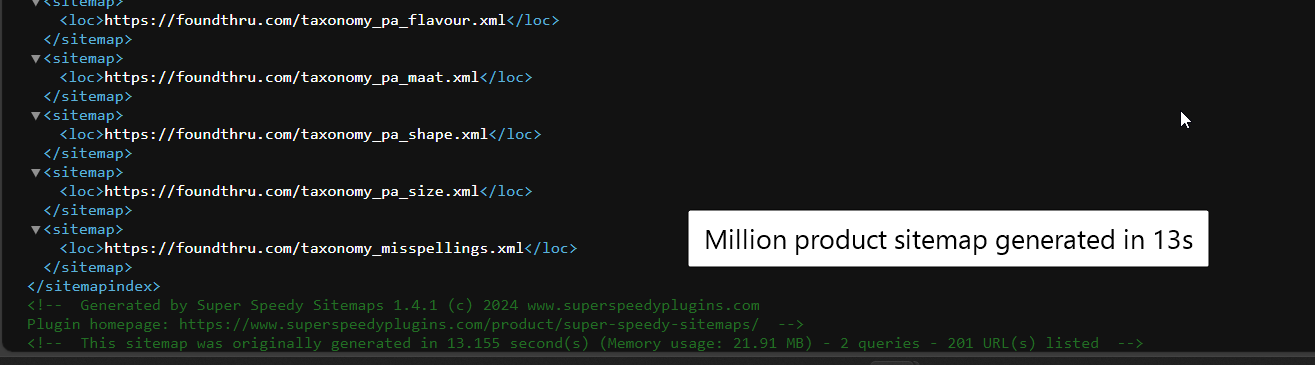
Generate large sitemaps without timeouts
Pre-generate and cache XML sitemap files instead of rebuilding a huge sitemap on every crawler request.
How large sitemaps stay manageable
If your sitemap takes tens of seconds to generate, times out, or becomes another expensive uncached WordPress request, crawlers may get an error instead of your URLs. Super Speedy Sitemaps builds a sitemap index, splits large post sitemaps into manageable files and caches the result on disk for repeat requests.
This plugin has been forked from the Better XML Sitemap plugin, with security holes fixed and performance improved even further.
Google News Sitemap
Easily integrate a Google News Sitemap into your sitemap index. This specific sitemap lets you individually notify search engines, and whenever a new post is published under a news category, it automatically alerts all the search engines you have chosen.
Image Sitemap
If any of your posts, regardless of their type, include a featured image, you can add those images to a sitemap dedicated to posts.
Sitemap Index
A sitemap index is a central directory that organises multiple sitemaps within it. It is required because of the global industry sitemap limit of 50,000 URLs per sitemap.
To let you have more than 50,000 items, the index itself can contain up to 50,000 entries, each linking to a deeper page of your sitemap, which gives you effectively unlimited sitemap sizes.
To get your URLs recognised and indexed by search engines, submitting just the sitemap index is enough. There is no need to submit each sitemap individually, which simplifies the process significantly.
Measured on a million-product store
Tested on our million-product store, the sitemap index is the slowest part of your sitemap to generate, but it still was faster than Yoast and Rank Math in this test.
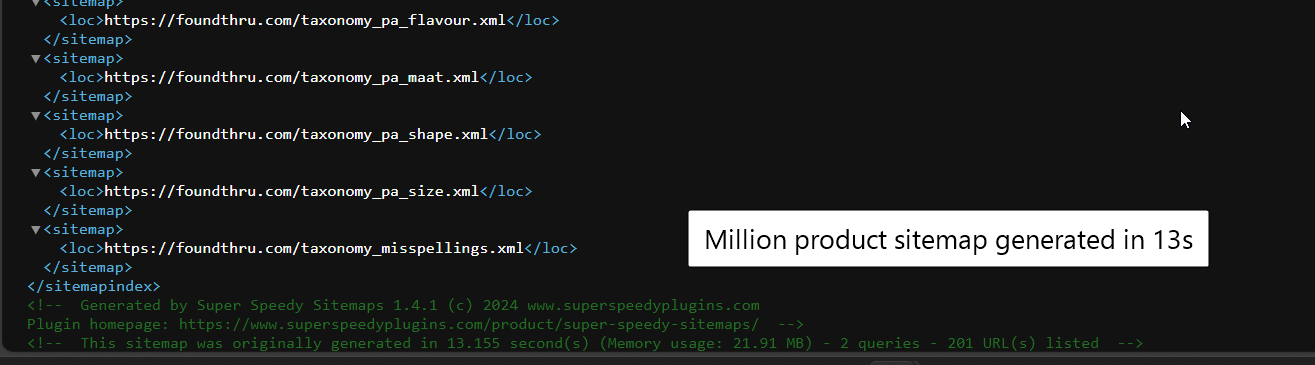
Large sitemap page performance
Without Scalability Pro installed, Super Speedy Sitemaps is not quite as fast as you might like: generating a list of 5,000 URLs takes about 24 seconds. With Scalability Pro installed and the sitemap index created, these pages generate in 0.8 seconds. As these pages are cached once generated, and are only used as indexes by Googlebot, that is comfortably fast enough.


Splitting post-based sitemaps
Super Speedy Sitemaps automatically divides large post sitemaps into smaller sections once a limit is reached. If you are managing 200,000 posts and prefer each sitemap to contain 10,000 posts, the plugin splits post.xml into 20 separate parts, from post_part1.xml to post_part20.xml. This gets you past the 50,000 URL limit without needing custom modules, and keeps each sitemap smaller, lighter and quicker to generate.
Multisite compatible
Every site in your network gets its own sitemap index and corresponding sitemaps.
- On a sub-domain setup, the sitemap index is at
http://sub-domain.example.com/sitemapindex.xml. - On a sub-folder structure, find your sitemap index at
http://example.com/sub-folder/sitemapindex.xml.
Your main site always hosts a central sitemap index, available at http://example.com/sitemapindex.xml. Using the sub-domain strategy also lets each sub-domain keep its own robots.txt file.
Custom sitemaps using modules
You can build custom sitemaps through modules. Each module is a single .php file that tells Super Speedy Sitemaps how to construct a sitemap file, and you are free to extend the existing modules or write brand new ones.
The plugin ships with a base class for module development, with a simple, documented API. Because you define the modules yourself, you can include URLs that WordPress and the built-in providers cannot discover.
Questions before you switch
What changes, what does not, and what the server needs.
Get it Free
Free download. Install in seconds.
Works well with
Some combinations get a bigger discount than others. Add this set to your basket to see its price.


Alek H. (verified owner) –
It’s not working; clicking to generate the sitemap leads to a 404 error page.
Dave H. (verified owner) –
Super Speedy StaffFlush permalinks by visiting Permalinks and hitting save, also flush your object cache. It’s working well for many people including me.
Timothy L. (verified owner) –
It gives you a lot of control over your sitemaps more than other SEO plugins; it also makes it possible to cache it to make it even faster. You can fine-tune what you want to have in the site map.